Probing the Six-Planet Architecture of HIP 41378 through TTVs with CHEOPS and TESS
Jun 24, 2025· ·
0 min read
·
0 min read
Pietro Leonardi
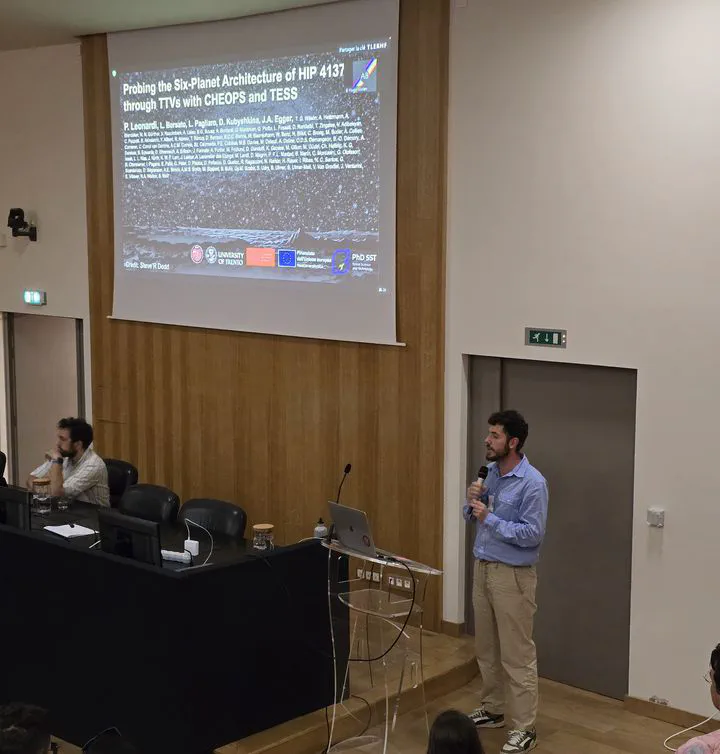 Image credit: Valentina Granata
Abstract
In multi-planet systems, gravitational interactions can induce transit timing variations (TTVs), with amplitudes significantly enhanced near mean-motion resonances (MMRs), making them easier to detect. In rare cases where both TTVs and radial velocity (RV) measurements are available, joint analysis can break degeneracies and yield robust planetary and system characterization. Detecting and validating small, long-period planets through these methods remains a major challenge, especially in complex multi-planetary configurations. In this context, the multi-planet system HIP41378 hosts five transiting planets with periods ranging from 15 to over 540 days, offering a unique opportunity to investigate wide, dynamically complex systems. We present an intensive space-based photometric follow-up of HIP41378, combining 15 new CHEOPS observations with eight TESS sectors, as well as data from K2, Spitzer, HST, and HARPS spectra. Using the N-body integrator within TRADES, we dynamically modeled the TTVs and RV signals of the two inner sub-Neptunes. These planets, HIP41378 b (Pb=15.57 days, Rb=2.45 R⊕) and HIP41378 c (Pc=31.71 days, Rc=2.57 R⊕), are nearly (~1.8%) in a 2:1 period commensurability. We report a clear detection of anti-correlated TTVs with amplitudes of 20 minutes for planet b and greater than 3 hours for planet c. Our precise determination of the masses, eccentricities, and radii of these planets enabled us to constrain their volatile-rich compositions and reconstruct the evolutionary histories of their primordial atmospheres. We dynamically confirm the planetary nature of HIP 41378 g, a non-transiting planet with a period of ~64 days and a mass of ~7 M⊕, located near a 2:1 commensurability with planet c. Finally, we provide new insights into the three outer planets (P>300 days), constraining the period of HIP41378 d and identifying several aliases for HIP41378 e. Our analysis suggests that the system could be placed in a double resonant chain, highlighting its complex dynamical architecture.
Date
Jun 24, 2025 12:00 AM
Event
Location
LAM, Marseille