Observing and modeling the orbit of a 542-Day transiting giant with large Transit Timing Variations
Jul 2, 2026· ·
0 min read
·
0 min read
Pietro Leonardi
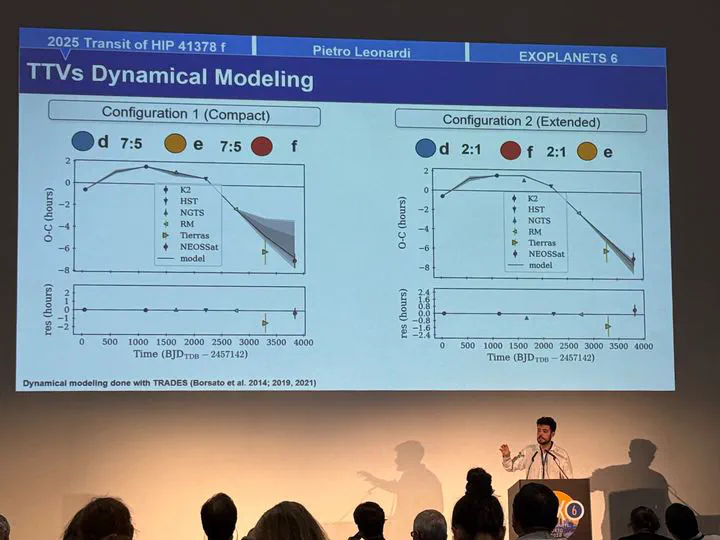 Image credit: Deepak Bisht
Abstract
Characterizing long-period transiting exoplanets is inherently challenging due to the rarity and long duration of transit events, yet these systems provide unique insights into planetary formation and migration, exomoons detection and primordial atmospheres by probing a sparsely populated region of the exoplanet parameter space. The complexity increases further for long-period planets near mean-motion resonances, where transit timing variations (TTVs) can reach amplitudes of several hours to days. We present a coordinated space- and ground-based observing campaign, using photometry from NEOSSat, multiple LCOGT sites, MuSCAT3 and Tierras, to capture the 19-hour transit of the long-period giant exoplanet HIP 41378 f (P = 542 days) on 31 October 2025. Our transit analysis constrains the time of inferior conjunction to TC,7 = 2460980.893 ± 0.028 BJDTDB, occurring 1.7 hrs later than predicted, making HIP 41378 f the longest-period transiting exoplanet known to exhibit measurable TTVs. By combining this new precise measurement to the transit timings of the two outer planets in the system (HIP 41378 d and HIP 41378 e), we perform a dynamical modeling of the system, refine the ephemeris of HIP 41378 f, and predict future transit events for all three outer transiting planets
Date
Jul 2, 2026 12:00 AM
Event
Location
Porto